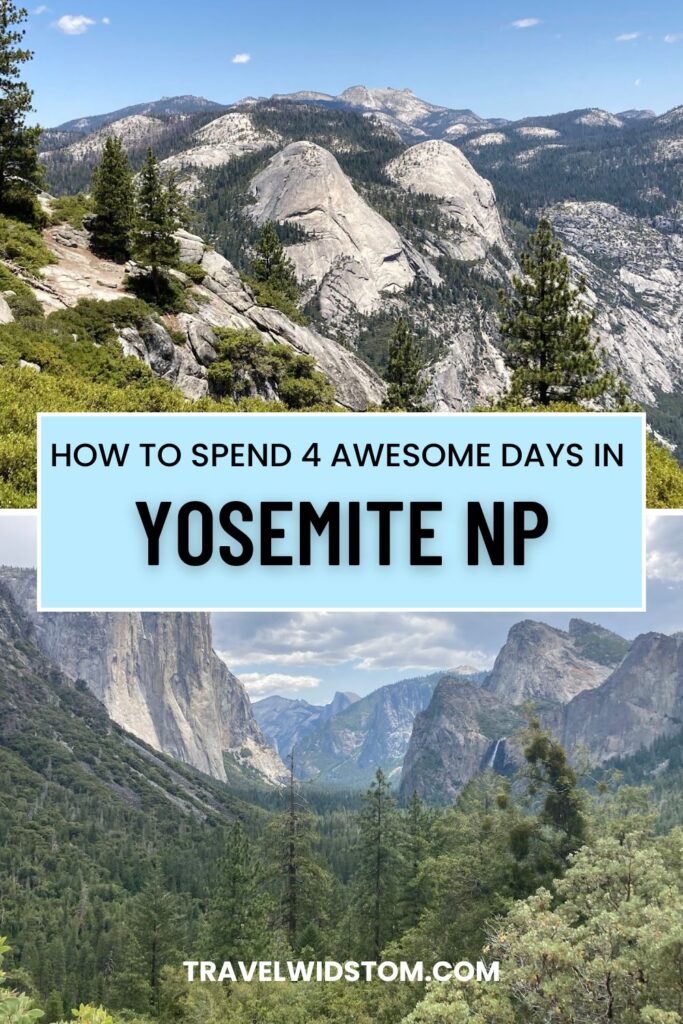
Planning the perfect Yosemite itinerary can be daunting, but after visiting this iconic park five times, I’ve narrowed down exactly how to see the best of it.
Having explored over 25 national parks, Yosemite National Park remains my absolute favorite. In this guide I’m sharing, my ultimate 4 day itinerary for Yosemite based on years of experience, from my first visit at age five to my most recent adventures with my family.
The following are things that you will find in this Yosemite itinerary so that you can plan the best trip possible.
- 4 Day Yosemite Itinerary
- Best Time to Visit Yosemite
- Places to Fly Into
- Places to Stay
- Entrance Reservations
- Yosemite Entrances
- Getting Around Yosemite
- Parking
- Tours to Yosemite
4 Day Yosemite National Park Itinerary
This 4 day Yosemite itinerary has many different hikes in it. I’m not going to go into a lot of detail about the hikes in this itinerary. I have a post titled “10 Fantastic Hikes to Do in Yosemite National Park.”
In that post, you’ll find out information about the difficulty of the different hikes, the distance of the hikes, elevation gain, parking, time it will take to do the hike, what to expect on the hike, and various tips. There is a link at each one of the hikes in this itinerary that you can click to read more about the hike if you want to.

Day 1 Highlights
Mariposa Grove Welcome Plaza
Grizzly Giant Loop Hike in Mariposa Grove
Glacier Point
Taft Point and the Fissures

Mariposa Grove Welcome Plaza
If you enter the park through the south entrance, you can take the first road to the right out of the roundabout to go to the parking lot for the Mariposa Grove Welcome Plaza. The lot is pretty big with about 300 parking spaces and it has two tiers.
The Mariposa Grove Welcome Plaza has restrooms (which are quite nice), visitor information, and the Depot, which is a Yosemite Conservancy bookstore. The plaza is also where you will get on the shuttle to take the 2 mile ride back to the Mariposa Grove. The only vehicles allowed back to the grove while the shuttle is running are vehicles with disability placards.

Grizzly Giant Loop Hike in Mariposa Grove
The Mariposa Grove is the largest grove of sequoias in Yosemite. There are over 500 mature Sequoia trees in the grove. I don’t know about you but there is just something majestic about huge trees.
Once you get dropped off by the shuttle, there are 4 different hikes that you can do while in Mariposa Grove. If hiking isn’t your thing there is a short hike on a nice boardwalk around some of the trees that is only .3 miles long. Our family did the 2 mile Grizzly Giant Loop trail. If you want to learn more about the hike, you can click the following link.
If you want to see the Grizzly Giant, which is the largest tree in Yosemite, but you don’t feel like walking two miles. You can return the same way that you came which will shorten the hike by a half a mile.

Glacier Point
There are numerous places in Yosemite where you can get spectacular views of the park. With that being said, many people would argue that Glacier Point has all of the other places beat. It truly is hard to beat the views there. A few of the things that you can see from Glacier Point include: Half Dome, Yosemite Valley, Yosemite Falls, and the Yosemite back country.
The road going to Glacier Point is usually open from late May to late October or early November. In the winter time, you can cross country ski 10.5 miles to Glacier Point. I’ll wait for the thaw.
You don’t have to hike the trail to enjoy great views at Glacier Point. I would highly recommend it since the hike is easy and you traveled all that way. You can learn more about the hike by clicking here.

Taft Point and the Fissures
Taft Point is a short 5-10 minute drive from Glacier Point on Glacier Point Road. Just like with Glacier Point, you get spectacular views of Yosemite but from a different vantage point.
You actually can’t see Glacier Point from Taft Point and vice versa. From Taft Point you can see El Capitan, Yosemite Valley, and Yosemite Falls. You can also look down through various fissures, or cracks, in the granite near the edge.
The hike to get to Taft Point and the Fissures is 2.3 miles round trip. You can read my post about the hike by clicking here.

Day 2 Highlights
Upper Yosemite Falls Hike
Eat at Base Camp Eatery
Lower Yosemite Falls Hike
Yosemite Welcome Center

Upper Yosemite Falls Hike
Upper Yosemite Falls is the tallest waterfall in North America at 2,425 feet high. You can easily see Yosemite Falls from numerous vantage points all throughout the park. So, you don’t have to hike nearly 3,000 feet up to enjoy the falls.
The hike to the top isn’t for the faint of heart. If you do the hike, you won’t look at the falls the same way ever again. At least, I don’t look at the falls the same way. If you need some inspiration, my one daughter Cassidy, was 5 months pregnant and made it to the top. She was a beast! You can do it!! You can click on the link here to find out more about the hike to decide if it’s something you want to tackle.

Eat at Base Camp Eatery
The Base Camp Eatery is located right beside the Yosemite Valley Lodge. They serve breakfast, lunch, and dinner. If you are a Starbuck’s fan, you will like this place since it also has a Starbucks. You can dine in or you can get food to go.
The reviews for this place on Google aren’t that high so, I wasn’t expecting much. I think the whole family was surprised by how good the food was. The fries and chicken sandwich that I had were really good.

Lower Yosemite Falls Hike
Unlike its brother, Upper Yosemite Falls, the hike to Lower Yosemite Falls is much easier on the mind and body. The hike to the falls is flat and is .5 miles long round trip. There is a nice area in front of the falls to get pictures. You can click the link to read my post to get more information about this hike.

Yosemite Valley Welcome Center
The Yosemite Valley Welcome Center is located beside Yosemite Village Parking and the Village Store. You can get off at shuttle stops 1 and 2 if you’re taking the shuttle. At the Welcome Center you can get trail maps, questions answered by rangers, junior ranger booklets and more.
Helpful Tip
As I mentioned above, the Village Store is located close to the Yosemite Valley Welcome Center. Inside the store, you’ll find a place to buy a souvenir and a decent sized grocery store with a pretty good selection of food. It’s a good place to pick up any snacks or additional food that you need while in the park. The prices are higher than what you would find outside of the park but they weren’t as high as I thought they would be.

Day 3 Highlights
Sentinel Dome Hike
Tunnel View
Bridal Veil Falls
Eat at Base Camp Eatery
Yosemite Valley Hike

Sentinel Dome Hike
The hike to Sentinel Dome starts at the same parking lots where you park to hike to Taft Point. If you have the time and energy, you can do both Taft Point and Sentinel Dome the same day. Unfortunately, we didn’t have the energy to do both hikes the day that we hiked to Taft Point.
Once you get to the dome you can get some nice views without going to the top of the dome. If you want next level views, you need to go to the top. Believe me you won’t be disappointed. You can read my post about the hike by clicking the link.

Tunnel View
Tunnel View is the most iconic view in all of Yosemite. I checked with Google and even Google agrees with me. Seriously though, once you go through the Wawona Tunnel, you see that spectacular view of Yosemite Valley, Half Dome, and Bridal Veil Falls.
Depending on what time of day you are there, parking can be hard to find since there are only two small parking lots. The first one is on the left side of the road after exiting the tunnel. The other one is on the right side of the road.
You don’t have to do any hiking to enjoy the views. If you want to get away from the crowds and still have great views, you can do the Artist Point hike.

Bridal Veil Falls Hike
Bridal Veil Falls can be seen from Tunnel View but it’s definitely worth a stop to see the 620 feet falls up close and personal. It’s only around a mile and a half from Tunnel View to the Bridal Falls Trailhead.
The main parking lot near the trailhead isn’t that big. If it’s full, you can park along the road as you drive back to the falls. You can also park along the road that leads into the valley. You will have to walk a little but any walk in the park is worth it. You can click the link to read my post about the hike.
Eat at Base Camp Eatery
It was so good the first time so we went back again. There are a number of other places in the valley to grab a bite to eat. You can pick this or another restaurant.

Yosemite Valley Hike
It’s one thing to see El Capitan, Yosemite Valley Falls, and Half Dome from different vantage points like Taft Point and Glacier Point. Once you get into the valley, you have a whole different perspective of those landmarks and others. The valley also has the Merced River running through it and green meadows.
There are a number of trails that you can follow when enjoying the valley. My wife and I did a little over a 2 mile loop. As you do the loop, you can also do little excursions that can get you away from some of the hustle and bustle of the valley floor. You can read more about our hike by clicking the link.

Day 4 Highlights
Vernal Falls
Yosemite Valley
Eat at Degnan’s Deli

Vernal Falls
The most popular hike in all of Yosemite is the Vernal Falls/Nevada Falls hike via the Mist Trail. We did the hike just to Vernal Falls instead of going all the way to Nevada Falls. The nice thing about the hike to Vernal Falls is the fact that it’s mostly paved. That isn’t the case for most hikes in the park.
The last section of the hike to the top of Vernal Falls consists of over 600 stairs that you need to climb. Just think of it as a stairmaster workout with a great view. If you want to take a shower, then don’t wear any rain gear. The mist can be quite heavy especially when the river is running heavy during spring and the early summer.
The hike to Vernal Falls is just over 3 miles long. If you want to go to Nevada Falls, it’ll be another 3.3 miles. The hike to Nevada Falls isn’t paved and is tougher than the hike to Vernal Falls. You can find out more about the hike to Vernal Falls by clicking the following link.

Yosemite Valley
Once you do the Vernal Falls hike, you can keep your car parked where it’s at and take a shuttle, walk or rent a bike or you can roll the dice and move your car if you want to. No matter what you do, there is always more that you can enjoy in the valley.
You can go down to the Merced River and take a dip. There is a beach and picnic area near the Swinging Bridge. I passed on the dip because I still have nightmares from my dad making my sister and I go in the freezing cold river near the Lower Yosemite Falls to take a picture when I was 5. I don’t think I ever cried so hard.
Some other things that you can do in the valley include: enjoying the Yosemite Museum, looking at the Ansel Adams Gallery, taking in a free program during certain days at the Yosemite Conservation Heritage Center, tubing down the Merced River, or just strolling through the valley enjoying the wonderful views from God’s creation.

Eat at Degnan’s Deli
Deganan’s Deli is located between the post office and the Yosemite Welcome Center. They serve delicatessen sandwiches, pizza, breakfast favorites, coffee and espresso and baked goods. There are places to eat inside and outside.
My wife got a BLT and I got a Turkey sandwich and some chili. The kids working were very upbeat and we both thought that the sandwiches were really good and reasonably priced.
Best Time to Visit Yosemite National Park
This might sound like a copout and maybe it is but the best time to visit the park really depends on what you want to see and do. There are pros and cons for different months of the year.
April – May
Pros:
- Waterfalls are at their peak due to snowmelt.
- Spring flowers and lush meadows make the scenery vibrant.
- Mild temperatures (cool but generally comfortable).
- Fewer crowds than summer months.
Cons:
- Some higher elevation areas (like Tioga Pass) may still be closed due to snow.
- Variable weather—rain and occasional late snow possible.
- Limited access to certain trails or roads.
June – August
Pros:
- All park areas and trails are generally open.
- Warm, sunny weather ideal for hiking, climbing, and camping.
- Long daylight hours give more time for activities.
- Great for family trips and outdoor adventures.
Cons:
- Peak tourist season—crowds (make sure to pack your patience), busy parking, and crowded trails.
- Higher prices for lodging and campgrounds.
- Hot temperatures in Yosemite Valley can be uncomfortable mid-day.
September – October
Pros:
- Fall colors begin to appear especially in October, creating beautiful scenery.
- Summer crowds thin out, making the park feel more peaceful.
- Weather is generally mild and pleasant.
- Perfect for photography with clear skies and softer light.
Cons:
- Waterfalls may be lower or dry.
- Some facilities or trails may start reducing hours in late October.
- Cooler evenings and mornings; early snow possible in higher elevations by late October.
November – March
Pros:
- Snow transforms Yosemite into a winter wonderland—great for photography and snow sports.
- Few tourists; peaceful, serene atmosphere.
- Opportunities for winter activities like snowshoeing and skiing.
- Lower prices for lodging (except holiday periods).
- Firefall occurs on Horsetail Falls for a couple of weeks in February.
Cons:
- Tioga Pass and Glacier Point Road are closed due to snow.
- Some trails are inaccessible or require snowshoes/gear.
- Very cold temperatures and possible winter storms.
- Limited services and facilities; some lodges and campgrounds closed.
I know for some people you don’t have flexibility to come to the park during certain times of the year. For example, my wife is a teacher so the summer time is going to be the best for us. I would highly recommend coming to the park no matter if it’s during your preferred time. You won’t regret it. I wouldn’t steer you wrong.
Places to Fly into to Go to Yosemite
There are two main options to fly into to go to Yosemite. You can fly into San Francisco or Fresno. Our family flew into San Francisco since the flight from Cleveland was a nonstop and it was in the morning which is what we wanted. Plus, it cost less points to fly into San Francisco versus Fresno.
San Francisco Airport (SFO)
It’s about a 3.5 drive to get to the west entrance of Yosemite from San Francisco International Airport (SFO). It’s about a 4 hour drive if you are going all the way to Yosemite Valley.
If flying nonstop to your destination is important to you, San Francisco is going to be your best bet.
Fresno Yosemite International Airport (FAT)
Fresno is the closest major airport to Yosemite National Park. It’s about a 1 hour and 40 minute drive to the south entrance and 2 hour and 20 minute drive to Yosemite Valley.
Fresno only has 13 cities that fly nonstop into it. Most of the cities that do are west of the Mississippi River. The only two cities east of the Mississippi River that fly directly into Fresno are Chicago and Atlanta.
Other Options
If you are looking to try to get the best deal on a flight, you can also look at the following airports.
- San Jose
- Oakland
- Los Angeles
Places to Stay
Ideally the best place to stay for convenience is inside the park. By staying in the park, you don’t have to deal with getting in the park each day. This can be a pain depending on what entrance and what time of day you are trying to get into Yosemite.
The great thing is there are many different places and styles of lodging that you can stay inside of the park. You can stay in a hotel, tent cabins, or at a campground in a tent or RV.
Hotels in the Park
Yosemite Valley Lodge– Located in the Yosemite Valley near Yosemite Falls.
The Awahnee– An iconic and pricey hotel located in Yosemite Valley with fantastic views.
Wawona Hotel– Currently is closed.
Tent Cabins and Campgrounds
Curry Village– Tent cabins with views of Half Dome and Glacier Point.
Housekeeping Camp– Three sided structures with canvas roofs overlooking Half Dome.
White Wolf Lodge– Tent cabins and rustic lodge located 30 miles from Yosemite Valley.
Tuolumne Meadows Lodge– Tent cabins located 60 miles from the Yosemite Valley.
High Sierra Camps– Five camps along a loop trail that have tent cabins.
13 Campgrounds for Tents and RVs– There are 13 campgrounds located in the park.
Yosemite West, Wawona, and Foresta
Beside the above options, you can also stay at Yosemite West, Wawona, and Foresta which are all located inside of Yosemite National Park. There are all kinds of different houses and condos that you can rent in each one of these places.
Our family stayed in Yosemite West. Yosemite West is a 30 minute drive to Mariposa Grove, Glacier Point, or the Yosemite Valley. So, it’s centrally located in the park.
We rented the house through Scenic Wonders. The house that we rented was called Boulder Ridge. It was a 2,200 sq. ft. home with 3 bedrooms and 2 baths. There was a nice sized kitchen with a large table to eat at and a spacious living room to watch TV. We totally enjoyed our stay there and would do it again.
If you find a home that you may like to rent, you can check to see if it’s on other sites like Airbnb or Vrbo to see if there is a price difference.
Helpful Tip
Since we were staying in a house we needed to buy groceries. The nearest large grocery stores outside of the park are about an hour drive from Yosemite West in Oakhurst. We debated whether to buy groceries the night before going into the park or go grocery shopping after spending our first day in the park.
We brought a number of collapsible coolers with us on the trip. Driving 2 hours round trip after spending a busy day in the park didn’t seem appealing to us. So, we bought groceries in Fresno the night before. In the morning, we put ice in the coolers to keep what we needed cold. It ended up working out well for us.
Places to Stay Outside of Yosemite National Park
If you don’t want to or can’t stay in the park, there are numerous towns where you can stay and drive into the park. The following towns are good options.
- El Portal
- Mariposa
- Oakhurst
- Bass Lake
- Groveland
Entrance Reservations
The National Park Service has done away with the reservation system for Yosemite National Park for 2026. You can enter the park at anytime without having a reservation.

Yosemite National Park Entrances
Yosemite National Park has five main entrances, each providing access from different directions and offering unique routes into the park. Here’s a breakdown of each:
1. Big Oak Flat Entrance (Highway 120 – Northwest Entrance)
- Location: West of the park, off Highway 120 near Groveland.
- Best For: Visitors coming from the San Francisco Bay Area or northern California.
- Highlights: Provides access to Yosemite Valley and the Tuolumne Meadows area (though Tioga Pass may be closed in winter).
2. Arch Rock Entrance (Highway 140 – Southwest Entrance)
- Location: West of the park, near Mariposa.
- Best For: Travelers from the Central Valley and Merced area.
- Highlights: Often considered the most reliable entrance in winter because it rarely closes due to snow. It provides a scenic route along the Merced River into Yosemite Valley.
3. South Entrance (Highway 41 – Wawona Road)
- Location: South of the park, near Oakhurst and Fresno.
- Best For: Visitors coming from Southern California or Fresno area.
- Highlights: Access to Wawona, Mariposa Grove of Giant Sequoias, and Yosemite Valley. Offers a more forested, scenic approach.
4. Tioga Pass Entrance (Highway 120 – Northeast Entrance)
- Location: Eastern side of the park, near Lee Vining and Mono Lake.
- Best For: Travelers from eastern California or Nevada.
- Highlights: Access to high-country areas like Tuolumne Meadows and Tenaya Lake. Note: Usually closed in winter (roughly November–May) due to snow.
5. Crane Flat Entrance (Highway 120 – North/Northwest Entrance)
- Location: Off Highway 120 near Big Oak Flat, often considered part of the northwest approach.
- Best For: Visitors heading to Yosemite Valley from the northwest and for reaching high-country trails.
- Highlights: Provides access to the less crowded northern parts of the park, including trailheads to backcountry areas.
The earlier that you can get to an entrance the less likely you’re going to have to wait to enter the park. For example, on this trip, we got to the south entrance or should I say we got within 1.5 miles of the south entrance just after 8 am. It took us over an hour to get to the gate.
Getting Around Yosemite
After driving into the park, you’ll naturally use your car to get from place to place as needed. Depending on your destination, though, you may also want to take advantage of the park’s shuttle system. For example, Yosemite Valley is the most popular area in the park. It offers several options for getting around. You can explore on foot, rent a bike, or hop on the free shuttles that run throughout the valley.
Valleywide Shuttle: The valley wide shuttle stops at all 19 different stops in the valley. Buses arrive every 12 to 22 minutes all year round. Hours are from 7 am to 10 pm. They have shorter hours during the winter months.
East Valley Shuttle: This shuttle is limited to Yosemite Village, Curry Village, Pines campground, and trailheads in eastern Yosemite. Buses run every 8 to 12 minutes all year round. Hours are from 7 am to 10 pm. The hours are shorter during the winter months.

The following are other shuttle services inside of the park.
Mariposa Grove Shuttle– This free shuttle provides service from the Mariposa Grove Welcome Plaza to the Mariposa Grove.
Yosemite Valley-Tuolumne Meadows Hikers Bus– This shuttle operates from mid-June to October. The shuttle runs from Yosemite Valley to the Tuolumne Meadows Visitor Center with various stops along various trailheads on Tioga Road. There is a cost to this shuttle.
Glacier Point Tour– The tour starts at Yosemite Valley Lodge and goes to Glacier Point. Many people take the tour one way and then hike back to the valley.
YARTS– For a fee, YARTS offers shuttle services from various places outside of Yosemite National Park into the park.

Yosemite Parking
Let’s get ready to rumble! Depending on what time of year and what time of day you are trying to find a parking spot, the following sentence can be true. That may or may not be hyperbole.
Yosemite Valley Parking
Yosemite Valley is really the heart of the park. There are many iconic landmarks like El Capitan, Half Dome, Yosemite Falls, and Tunnel View. The valley also has numerous trailheads for hikes, a visitor’s center, restaurants, hotels, and more.
Yosemite Valley’s popularity comes from everything it has to offer, but that also means parking can be a challenge. As shown on the map below, there are several designated areas where you can park while visiting the valley.

The following tips can help you find a parking spot in the valley
- This is a theme but the earlier that you can get to the valley the easier it will be to find a parking spot. You can always take a nap later in the day.
- There is some parking on the side of the road on the one way loop in the valley. You can take a short walk to get to the different places or wait for a shuttle.
- Once you find a parking spot, plan on keeping the car parked there until you need to leave. You can walk, bike, or take the shuttle throughout the valley.
- If you can’t find parking in the heart of the valley, consider parking a little further out and taking the shuttle in.
Parking Elsewhere in Yosemite
No matter if you go to places like Glacier Point, Taft Point, Bridal Veil Falls, and Tunnel View the rule about getting there early applies. That isn’t always going to be possible, so you need to be patient, I know it’s easier said than done. You may have to circle a parking area a few times before finding a spot or drive by and circle back to find a spot. I’m speaking from experience.
Tours to Yosemite
A tour into Yosemite may be a good option for someone who likes to meet new people and take all of the guess work out of the experience. Below are a few different options of tours that you can take into Yosemite.
Yosemite Full Day Tour with Lunch and Hotel Pickup
San Francisco: Yosemite Park 2 Day Trip with Accomodation
Yosemite Valley 3 Day Camping Adventure
Yosemite Valley 3 Day Lodging Adventure
Final Thoughts
As you start planning your Yosemite trip, I hope this has given you some helpful ideas like where to fly into, where to stay, what to see and do, places to park, how to get around, and more.
Once you take all the different factors into consideration, you can then plan out the best trip that you can to meet your needs. This 4 day itinerary that I’ve shared will hopefully give you some more insight on what you can see and do while in Yosemite National Park.
I hope that you enjoy your trip to Yosemite National Park and if you have any questions or comments please leave them. I would love to hear from you.
If you want to see more itineraries, ways to save on travel, other travel related topics, and how to earn and maximize credit card points, please go to my blog Travelwidstom.